Welcome to Fox Pest Control’s ultimate guide on carpenter bees! Whether you’re dealing with an infestation or just curious about these tiny creatures, we’ve got all the information you need. From facts and types to behaviors and carpenter bee treatment options, this guide covers it all. Let’s dive in!
What Do Carpenter Bees Look Like?
What Are Carpenter Bees?
Carpenter bees are like the lone rangers of the insect world—big, bold, and always flying solo. Unlike honey bees that live in bustling colonies, carpenter bees prefer to do their own thing. Their party trick? Creating cozy tunnels inside wood to lay their eggs. You might think they’re bumble bees at first glance because of their size and fuzzy yellow-and-black bodies, but take a closer look! Carpenter bees have a few tricks up their sleeves that set them apart, especially when it comes to how they interact with their surroundings.
What Do Carpenter Bees Look Like?
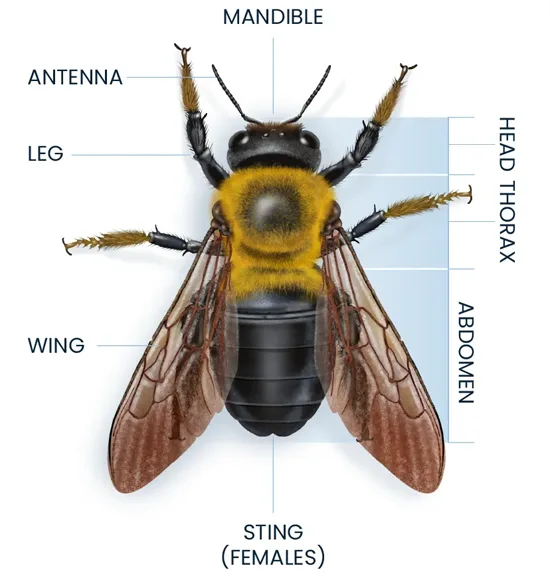
Carpenter bees are hard to miss once you know what to look for! These buzzing beauties are pretty big—around 1 inch long—and shine like little jet engines. Their bodies are a mix of black and yellow, kind of like bumblebees, but with a cool twist. The front half is all fluffy and covered in yellow or white hair, perfect for collecting pollen, while the back half is smooth and shiny, almost like they’ve got a polished coat of armor. Talk about a stylish insect!
How Many Carpenter Bees Are There?
Hold onto your hat—there are over 500 different species of carpenter bees! Yeah, you heard right: more than 500! Most of these buzzy builders live in tropical areas, but don’t worry—North America has its fair share too. While you can find them in many parts of the country, some species are more common in certain regions, depending on the climate.
Carpenter bees may all share the same love for burrowing into wood, but depending on where you live, the species you see might look a little different! There are around 30 species in the U.S., and each one has its own unique appearance and preferred habitat.
- In the eastern and central U.S., the eastern carpenter bee (Xylocopa virginica) is the most common. These bees are about an inch long, with fuzzy yellow or white hair on the front half of their bodies and shiny black abdomens. Males have a distinctive white patch on their faces, while females are solid black.
- Down in the Southeast, you might spot the southern carpenter bee (Xylocopa micans), which is entirely black but has a stunning blue or green metallic sheen when it catches the light.
- Out west, things get even more interesting! The valley carpenter bee (Xylocopa varipuncta), found in California and other warm regions, is a real showstopper. Females are shiny black, but males are covered in golden-brown fuzz, earning them the nickname “teddy bear bees.” The California carpenter bee (Xylocopa californica), another western species, is mostly black but has a patch of yellow or orange hair on its thorax.
No matter where they live, all carpenter bees have a knack for drilling into wood to build their nests. They love hanging around places like fences, decks, and the eaves of homes, especially in the spring and summer months when they’re most active.
In addition to being frequent visitors to backyards and homes, carpenter bees can also be found in wooded areas, parks, and gardens—basically anywhere there’s a good amount of wood and blooming flowers. These busy little builders need wood to make their nests and plenty of flowers to fuel their foraging adventures. So, if you’re in a place with a lot of plants and trees, you’re probably going to see these charming insects doing their thing. From big city backyards to quiet rural forests, carpenter bees are right at home wherever there’s wood and nature to explore!
From the tropics to the temperate zones, carpenter bees have adapted to all sorts of environments. Whether it’s warm, sunny spots or cooler, more moderate areas, these bees have made themselves at home all over the world. But one thing they all have in common? Their talent for burrowing into wood! That’s why they get the “carpenter” name—they’re basically the DIYers of the bee world, building their nests inside wood just like little construction pros.
Carpenter Bees Have Been Around for a Really, Really Long Time…
Carpenter bees have been buzzing around for a really long time—like, a really, really long time! In fact, these crafty creatures have been around for a jaw-dropping 40 million years! Fossil records show that carpenter bees first appeared during the late Eocene period, which was back when early mammals were just starting to evolve, and dinosaurs were long gone.
Over those millions of years, carpenter bees have truly perfected their craft. They’ve mastered the art of burrowing into wood, creating tunnels to lay their eggs and build nests. And while they’ve been busy woodworking, they’ve also become expert nectar foragers, adapting to all sorts of flowers and plants. As the climate shifted over time, carpenter bees made sure to adapt to their environment, thriving in tropical regions, temperate zones, and everywhere in between. Their ability to evolve and keep up with the times is pretty impressive—and it’s no wonder they’ve survived for so long, continuing their buzzing and building to this very day!
Do Carpenter Bees Bite, Sting, Damage Property, or Spread Disease?
When it comes to carpenter bees, they’re actually pretty chill—most of the time. These bees are relatively non-aggressive and don’t usually pose a threat to humans. They’re unlikely to sting unless they feel threatened or are provoked. Male carpenter bees, the ones with the bold buzzing and intimidating antics, may fly around you, but don’t worry—they can’t sting! They’re just showing off their bravado to protect their turf.
Female carpenter bees can sting, but they’re not looking for a fight. Since they’re busy building nests and laying eggs, they usually only sting if they feel directly threatened—like if you try to handle them or disturb their nest. So as long as you give them their space, you don’t have much to worry about!
Where carpenter bees really make an impact is with the damage they cause to property. Their burrowing habit is fascinating, but when it comes to your wooden structures, it can be a problem. Female carpenter bees drill into wood to create tunnels for their nests, and over time, this can lead to significant damage. Wooden decks, fences, eaves, and even the trim on your house can end up with holes or wear from these little carpenters at work. We’re going to share a little more about this damage in just a minute.
Some good news is that carpenter bees do not spread any harmful diseases to humans. While they do visit flowers and may carry pollen between plants, they don’t transmit anything dangerous to people. So, while they might make a little mess with their woodwork, you don’t have to be concerned about health risks.
Have a carpenter bee problem that needs fixing?
Life Cycle of Carpenter Bees
Let’s break down the fascinating journey of a carpenter bee, from egg to adulthood! Unlike honey bees that live in hives, carpenter bees are solitary insects, which means each female is responsible for building her own nest and raising her young.
- Step 1: Nest Building
- The female carpenter bee drills into wood, creating a tunnel for her eggs. These nests can be a few inches deep and have multiple chambers—like a tiny bee apartment!
- Step 2: Egg Laying
- She lays an egg in each chamber and leaves behind a pollen ball (a mix of nectar and pollen) as baby food. Each egg gets its own cozy, food-stocked room!
- Step 3: Sealing the Chamber
- Once an egg is placed, she seals the chamber with chewed-up wood, protecting it while the baby bee develops. Then, she moves on to the next egg!
- Step 4: Larval Stage
- The egg hatches into a hungry little larva, which stays put and munches on its pollen stash while growing bigger and stronger.
- Step 5: Pupal Stage
- After eating its fill, the larva transforms into a pupa, where it starts developing wings, legs, and its signature fuzzy bee look!
- Step 6: Time to Hatch!
- A few weeks (or months) later, the adult bee chews its way out of the tunnel, ready to explore the world! Males hatch first and hang out, waiting for the females.
How Long Do Carpenter Bees Live?
Most carpenter bees have a lifespan of about a year, though their active period is mainly in the spring and summer. The adults that emerge in late summer will overwinter inside old tunnels, hibernating until the weather warms up in spring—then they’ll come out, ready to start the next generation!
From tiny eggs to hardworking adults, carpenter bees have an incredible life cycle that allows them to thrive year after year. While their wood-drilling habits might make them a nuisance for homeowners, they play an important role in pollination and the ecosystem!
The Roles of Adult Carpenter Bees
Once carpenter bees reach adulthood, they don’t just sit back and relax—they have important jobs to do! Each gender has its own role to play, from protecting the nest to building the next generation.
Male Carpenter Bees: The Watchdogs
Male carpenter bees may look intimidating as they hover near their nests, but don’t worry—they can’t sting! Their main job is to defend the nest by buzzing aggressively at anything that gets too close, whether it’s another male, a predator, or even an unsuspecting human. It’s all a bluff, though—since they don’t have stingers, they’re all bark (or rather, all buzz) and no bite!
Female Carpenter Bees: The Builders and Mothers
Females are the real architects, using their strong jaws to drill into wood and create tunnels for their eggs. After laying an egg in each chamber, they stock it with a pollen ball for food and seal it off. They spend most of their lives building, nesting, and preparing for the next generation.
Pollinators on the Move
Both male and female carpenter bees are important pollinators. As they fly from flower to flower collecting nectar, they accidentally transfer pollen, helping plants reproduce. While they’re not as efficient as honey bees, they play a crucial role in pollinating many wildflowers, garden plants, and crops.
Even though they might be a nuisance around wooden structures, carpenter bees are essential to local ecosystems. Without them, many plants wouldn’t be able to grow and thrive!
Mistaken Identities: Buzzy Lookalikes
If you’ve ever mistaken a carpenter bee for a bumble bee, you’re not alone! These two bees look a lot alike with their large, fuzzy, yellow-and-black bodies, but a few key differences can help you tell them apart.
Shiny vs. Fuzzy
The easiest way to spot the difference? Check the abdomen!
- Carpenter bees have a smooth, shiny black abdomen with little to no hair.
- Bumble bees have a fuzzy, round abdomen covered in thick hair.
Solo Flyers vs. Team Players
Another big difference is how they live.
- Carpenter bees are loners. They prefer to tunnel into wood and make their own little nests, living a mostly solitary life.
- Bumble bees are social. They live in underground colonies with a queen and worker bees, much like honey bees.
Behavior Clues
Still not sure which bee you’re looking at? Watch how it behaves!
- Carpenter bees often hover near wooden structures, especially decks, fences, or eaves, since they like to burrow into wood.
- Bumble bees are usually found buzzing around flowers in gardens or fields, working as a team to collect nectar and pollen.
Even though they may look alike at first glance, carpenter bees and bumble bees live very different lives.
Behavior, Diet, and Living Conditions of Carpenter Bees
We’ve talked about how carpenter bees are known for their solitary behavior and how they don’t form colonies or hives. Here’s something else you may not know about them: Carpenter bees often “rob” flowers instead of pollinating them!
While they do help with pollination, some carpenter bees cheat the system by nectar robbing—instead of entering a flower the normal way and spreading pollen, they use their strong jaws to bite a hole at the base of the flower and sip nectar without ever touching the pollen. This sneaky shortcut lets them get food faster, but it doesn’t help the plant reproduce like traditional pollination does.
It’s a fascinating example of how animals adapt their behavior for efficiency—even if it bends the rules a little! Let’s look a little closer at what makes carpenter bees unique.
Nesting habits of Carpenter Bees
By now, you know that carpenter bees are nature’s little carpenters, and instead of using hammers and nails, they drill into wood with their powerful jaws. Their nesting behavior is truly fascinating, but if left unchecked, it can also be a headache for homeowners.
How Carpenter Bees Build Their Tunnels
Remember, unlike termites, which eat wood, carpenter bees chew through it to create tunnels where they lay eggs and store food. Their tunnels can be anywhere from a few inches to over a foot long—and if they reuse the same spot year after year, the network of tunnels can grow even bigger!
Where Do Carpenter Bees Nest?
These bees aren’t too picky about their wood choice, but they prefer soft, untreated, or weathered wood. Some of their favorite nesting spots include:
- Deck railings
- Fence posts
- Sheds and barns
- Wooden eaves and overhangs
- Porch beams and outdoor furniture
Basically, if it’s wood and left unpainted, it’s fair game!
Can Carpenter Bees Damage Wood?
A few carpenter bees won’t bring down your house, but their tunneling can weaken wood over time—especially if multiple generations use the same spot. The bigger problem is that woodpeckers love to snack on carpenter bee larvae, so they’ll peck at the tunnels, causing even more damage!
Have a carpenter bee problem that needs fixing?
How Do Carpenter Bees Communicate?
Carpenter bees might not have the sophisticated language that humans or other animals use, but they have their own way of getting their message across—and it’s all about buzzing and behavioral cues.
Buzzing for Attention and Territory
Male carpenter bees are the main buzzers in the group. They use loud, deep buzzing sounds to grab the attention of females and to mark their territory. If you’re near a wooden structure or garden and hear a low hum, it’s likely a male carpenter bee doing his best to announce his presence. The buzz isn’t just to be dramatic—it serves as a signal to other males that the area is already claimed. If another male tries to move in, the resident male will buzz even louder as a warning!
Buzzing to Attract Females
Males also use their buzzing as a way to attract females. A well-timed buzz tells females that a male is not only ready to mate, but also that he’s healthy and strong enough to protect a potential nesting site. It’s a little like a bee version of a personal ad, where the male shows off his energy and his territory to show he’s the right choice.
Behavioral Communication
While buzzing is the main way carpenter bees communicate, their behavior also speaks volumes. For example, males will often hover near the entrance to a nest or sit perched on a fence, watching and waiting for a female to come by. Their movements, such as darting around in front of the nest, help establish their position and intentions.
No Complex Conversations
Unlike some social insects, like honey bees, who communicate with each other through intricate dances, carpenter bees don’t have a complex “language.” Instead, their buzzing and territorial behaviors are simple, yet effective ways of ensuring that their mating season goes smoothly.
In the end, it’s all about sending the right message: “I’m here, I’m strong, and I’m ready to mate!” Carpenter bees may not have full-blown conversations, but their buzzing and behaviors are enough to keep their world in motion!
What Do Carpenter Bees Eat and How Do They Get Their Food?
Carpenter bees are true foraging experts when it comes to gathering their meals. They rely on nectar and pollen to fuel their busy lives, and their unique feeding methods make them an important part of the ecosystem.
Nectar: The Sweet Fuel
Carpenter bees primarily feast on nectar, which provides them with the energy they need to fly, forage, and build their nests. They are particularly drawn to flowers with tubular shapes, like those of the trumpet vine or plants from the mint family. These flowers are perfect for carpenter bees because they can easily insert their long tongues (called proboscis) deep inside to access the sweet nectar.
Pollen: The Protein Power
In addition to nectar, carpenter bees also collect pollen from flowers. Pollen is rich in protein, which is essential for their growth and reproduction. The female bees especially rely on pollen when they are building nests and laying eggs, as it helps nourish the larvae once they hatch.
Pollination: Accidental Helpers
As carpenter bees move from flower to flower, without meaning to, they pollinate plants in the process. Their fuzzy bodies are perfect for collecting and transferring pollen as they dive into flowers for nectar. This is a huge benefit to the plants, as it helps with reproduction and the growth of fruits, seeds, and new plants.
The Pollination MVP
While they aren’t as well-known as honey bees, carpenter bees are critical pollinators in many ecosystems. They help pollinate a wide variety of plants, from wildflowers to crops, and even garden favorites like tomatoes and berries. Their ability to forage effectively and visit different types of plants makes them an invaluable part of the natural food chain.
In short, carpenter bees aren’t just eating for themselves—they’re also helping to feed the environment by keeping plants healthy and thriving!
Signs of a Carpenter Bee Infestation
If you suspect you have a carpenter bee infestation, here are some key signs to keep an eye out for. These bees tend to be a bit sneaky, but their activities leave clear clues behind:
- Small, Round Holes in Wood: Carpenter bees create perfectly round holes about the size of a dime in wooden structures like fences, decks, siding, or eaves. These holes serve as entrances to their nesting tunnels.
- Sawdust-like Debris: As carpenter bees burrow into the wood, they chew through it, leaving behind sawdust-like debris, often seen around the entrance holes. This is a telltale sign of active tunneling.
- Visible Tunnels Inside Wood: If you can see inside the wood, you may notice long, dark tunnels where the bees have nested. These tunnels can go several inches deep and may expand as the bees continue to reuse the area year after year.
- Adult Carpenter Bees Flying Around: During the warmer months (especially spring and summer), you may notice adult carpenter bees flying around the area. Males are often seen hovering near nesting sites, while females are busy working on their tunnels.
- Woodpecker Activity: Woodpeckers are known to attack carpenter bee nests, so if you see woodpeckers pecking around your wooden structures, it might be a sign that bees are nesting nearby.
- Damage to Wooden Structures: Over time, the repeated tunneling by carpenter bees can weaken the wood, causing it to crack or even collapse if the infestation is severe.
- Buzzing Sounds: A telltale sign of carpenter bees nearby is the distinctive buzzing sound. While it’s not as loud as a swarm of honey bees, it can still be heard as the bees move around wooden surfaces or fly close to their nests.
If you notice any of these signs, it might be time to inspect the area more closely and consider reaching out to a carpenter bee control professional for assistance. Left unchecked, carpenter bee damage can build up over time and become a bigger issue!
Have a carpenter bee problem that needs fixing?
What You Can Do About Carpenter Bees
If carpenter bees are buzzing around your home or you’ve spotted the telltale signs of an infestation, don’t worry! There are plenty of steps you can take to prevent nesting and manage existing problems.
Preventing Carpenter Bees from Nesting
The best way to keep carpenter bees from moving in is by making your home less inviting to them. Here’s how:
- Seal Cracks and Gaps: Carpenter bees love to nest in soft, untreated wood, so make sure to seal any cracks, holes, or gaps in your wooden structures, like fences, decks, or eaves.
- Paint or Stain Exposed Wood: Bees are less likely to burrow into painted or stained surfaces, so adding a fresh coat of paint or stain can go a long way in discouraging them from settling down.
- Use Harder Woods: Carpenter bees prefer softer wood, so consider using harder, less chewable woods like cedar, redwood, or pressure-treated lumber for outdoor structures.
How Do I Get Rid of Carpenter Bees?
If you find yourself facing a carpenter bee problem, it’s time to call in the experts at Fox Pest Control. Whether the bees are in hard-to-reach places or woodpeckers are making things even worse, we know exactly how to handle the situation safely and effectively.
Even if you’ve already taken preventive steps, carpenter bees can still find their way in. That’s where our Home Protection Plan comes in. With our plan, you’ll get year-round protection against carpenter bees and many other household pests. Let the experts at Fox help handle this tricky pest and protect your home from wood damage.
Our technicians undergo regular training and are equipped with the latest knowledge on carpenter bee control, so you can trust us to handle the job. At Fox Pest Control, we’re committed to giving you peace of mind. Call us today to take care of your carpenter bee problem!