Free Inspections & EstimatesSame Day Service

Get Spider Control Near You

Squash the spider scare.

Feel comfortable in your home. Let Fox Pest Control take care of your spider problem.

Same Day Service

Free Inspections & Estimates

Satisfaction Guaranteed

Fox Pest Control technician inspecting kitchen for pests

Fox techs are experts at evicting your tiny tenants.

To ensure our customers’ safety, all Fox Pest Control technicians undergo a thorough screening process and complete extensive classroom training, along with ongoing on-the-job mentoring with an experienced technician.

The easiest way to get rid of spiders.

Got spiders? The best way to get rid of them is to call Fox Pest Control! We specialize in spider control and know how to handle any spider infestation. You can trust us to protect your home and take care of the problem. Plus, our expert spider exterminator services and Home Protection Plan keep your home safe all year long. We’re confident that our spider solutions will do the trick. If they come back, so do we—at no charge to you!

1

Schedule with Fox

Call Fox Pest Control today for a free inspection: (855) 953-1976.
Call before 2 pm and get same-day service.

Remote locations and other conditions may require next-day service.

2

Treatment

A certified technician will inspect your property and provide customized pest control treatment based on their findings.

3

Follow Up

Each service provides a detailed report and helpful tips to keep pests away. We return regularly throughout the year, increasing protection with every visit.

Hamilton Allen Ph.D., BCE

Certified Entomologist, Fox Pest Control

Spider Facts


Size: up to 3 inches
Number of legs: 8
Wings: no
Bites or stings: yes
Color: various
Carry disease: no
Damages home/yard: no
Most active season: year-round
Fox plan for this pest: Home Protection Plan

What do spiders look like?

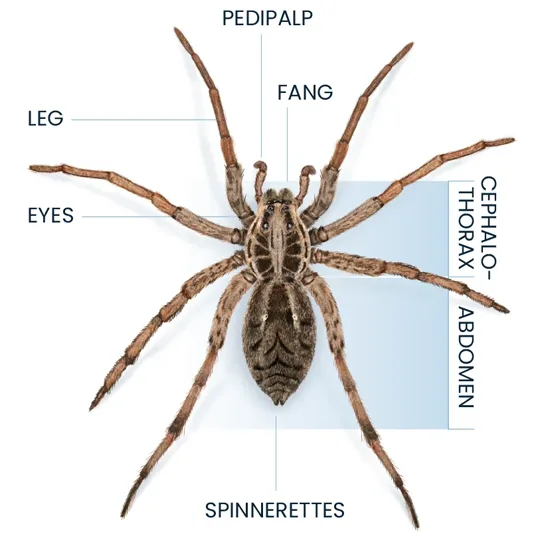
Spider Anatomy Diagram

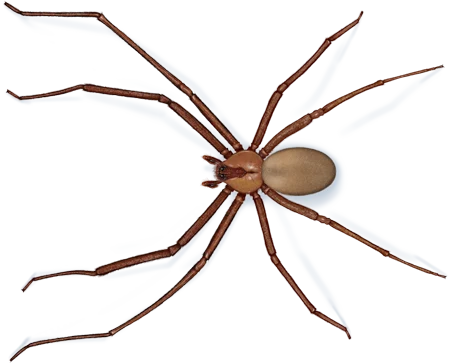
Brown Recluse

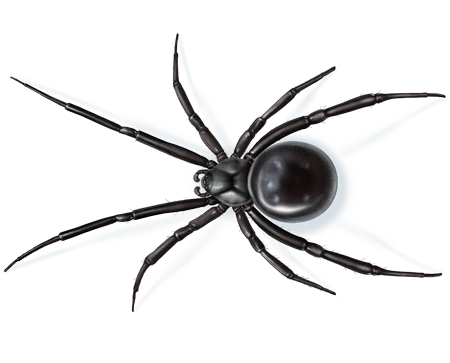
Black Widow

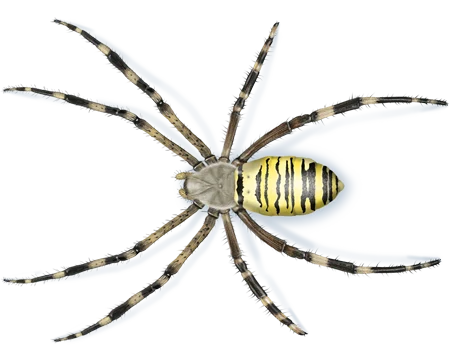
Orb Weaver

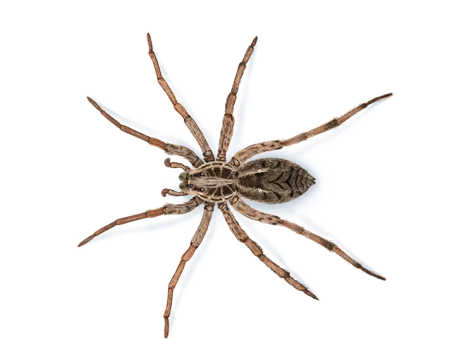
Wolf

Spiders are not insects.

They belong to a different group of animals called arachnids, which also include scorpions, ticks, and mites. One main difference between spiders and insects is the number of legs – spiders have eight legs, while insects have six.

Most spiders have eight eyes.

Their eyes are arranged in various patterns on their head, and not all species use their eyes in the same way. Some have excellent vision and use their eyes to hunt, while others rely more on other senses like touch and vibration.

Spiders have eight legs.

These legs help them move around, catch prey, and build webs. Their legs are covered in tiny hairs and equipped with specialized structures that help spiders grip onto surfaces and manipulate their environment.

How long a spider lives can vary widely depending on species, environment, and individual circumstances.

Some spider species may only live for a few months, while others can survive for several years. Generally, female spiders tend to live longer than males.

Spiders are carnivores, which means they eat other animals.

Most spiders feed on insects like flies, mosquitoes, and ants. Some larger spiders may even eat small vertebrates like frogs or lizards. They catch their prey using various methods, including spinning webs, ambushing, or actively hunting down their victims.

Spiders molt as they grow.

In spiders, molting is the process of shedding their hard exoskeleton, which protects their bodies. After molting, spiders appear with a new, larger exoskeleton, which eventually hardens to provide support until the next molt. Molting is essential for spiders to grow larger and replace damaged body parts.

To better understand these eight-legged arachnids, visit our Spider Pest Files—a valuable resource detailing their behaviors, species commonly found in homes, and tips for safe and effective management.


Pests that can be confused with spiders.

Spider beetles are often confused with spiders because they have long legs and round abdomens. They’re insects, though, with only six legs. Harvestmen, sometimes known as Daddy longlegs, are also confused with spiders, and they are arachnids but are part of the Oplilione family. They do not spin webs, and they only have two eyes. Read more about Daddy Longlegs in the FAQs below.

You might already know for sure that you have an spider problem. Here are a couple of the most common signs of spider infestation.

Seeing spider webs inside and outside your home, especially in corners, ceilings, windowsills, and even inside exterior light fixtures, is a clear sign of spider activity.

If you notice spiders crawling around your home, particularly in higher numbers or more often, it could suggest an infestation.

Spider egg sacs are variable in shape, size, and color but are generally round and often found in hidden areas like corners, behind furniture, or in the attic or basement.

Like other arthropods, spiders molt as they grow, leaving behind their shed exoskeletons. Finding these skins around your home can indicate spider activity.

Spiders often leave remnants of their prey, such as insect carcasses or small insects caught in their webs.

Seal entry points

Clean regularly

Reduce clutter and clean frequently

Fix water leaks

Regularly clean up spider webs

Store food properly

People like us.
Pests don't.

4.72 Average | 45,000+ Reviews

Bryan A.

I could not be more pleased with our initial home treatment today! Vincent arrived on time and was extremely thorough in his explanation of the services he performed. He was very polite, respectful of our inside spaces, and had a great attitude throughout the visit. A++ professional! Thank you!

Kayla B.

Overall - very satisfied with communication and job done for my first time ever hiring pest control. Very knowledgeable and explains everything. Makes it very easy to maintain for a super busy family like ours.

Fox Guarantee: We Come Back for Free!

    What type of property do you need help with?

    Are you a current customer?


    By clicking the checkbox, I am providing my eSign signature and consent to Fox Pest Control contacting me at the number above for marketing purposes including through the use of automated technology, SMS/MMS messages, and prerecorded and/or artificial voice messages (including AI generated messaging).  I acknowledge my consent is not required to purchase and I can connect with Fox Pest Control without providing consent by calling 833-667-3785. Message frequency may vary, and message & data rates may apply. Reply 'STOP' to unsubscribe. Reply 'HELP' for help. I also agree to the Fox Pest Control Privacy Policy and Terms of Use.

    Fox Pest Control technician talking to female customer

    Spider FAQs

    What are daddy longlegs?

    The term ‘daddy long-legs’ is commonly used to refer to various creatures, including spiders, harvestmen, and crane flies. Among these, only cellar spiders are true spiders. Harvestmen, while resembling spiders, lack venom and silk glands, and crane flies are long-legged insects known for their ability to fly and are considered agricultural pests.

    Which spiders are the most dangerous?

    There are two main spiders to worry about in the United States – black widows and brown recluses. To make sure your home is protected from these pests, call Fox Pest Control today. Spiders are included in our Home Protection Plan, which treats your home four times a year for common household pests. If you continue to see spiders between treatments, give us a call, and we’ll come back for free.

    Is the hobo spider dangerous?

    The hobo spider has long been considered dangerous because of its venom, but new studies suggest it might not be as harmful as people believed. While a bite might cause pain, redness, and swelling, serious reactions are uncommon. It’s still important to be careful around spiders and get help if bitten. However, scientists are still figuring out how much of a threat hobo spiders really are. The best way to protect yourself from spiders is to make sure they’re not living with you. Call Fox Pest Control today for a free inspection and customized treatment plan. Let us take care of any pests you may have.

    What is a black widow spider?

    A black widow spider is a venomous spider known for its shiny black body and distinctive red hourglass-shaped marking on its abdomen. The name “black widow” comes from the female’s habit of eating the male after mating. Female black widows are considered dangerous due to their potent venom, which can cause severe symptoms in humans. They are not aggressive unless threatened.

    How venomous are black widow spiders?

    In most species, the male black widow venom isn’t very potent at all and isn’t likely to cause harm to humans. Reportedly, the female black widow spider’s venom is 15 times stronger than rattlesnake venom. Their venom has toxins that can make people feel very sick, with symptoms like severe pain, cramps, nausea, and sweating. While black widow bites can be dangerous, especially for young kids or older people, it’s rare for someone to die from them if they get medical help quickly.

    Keep your home safe from pests with Fox Pest Control. Our Home Protection Plan covers spiders and other common household pests, providing four treatments every year. If you see spiders between treatments, contact us, and we’ll return to your home at no additional charge.

    Where are brown recluse spiders found?

    Brown recluse spiders are primarily found in the central and southeastern United States. They are native to regions such as Texas, Oklahoma, Kansas, Missouri, Arkansas, Louisiana, Mississippi, Alabama, Georgia, Tennessee, Kentucky, and sections of the surrounding states. However, they can also be found in other areas of the United States, particularly in states with warmer climates. Brown recluse spiders prefer dark, secluded places such as basements, closets, attics, sheds, and woodpiles to build their irregular webs.

    If you don’t want to find brown recluses inside your home, call Fox Pest Control today. We’ll take care of them and give you peace of mind.

    How venomous are brown recluse spiders?

    Unlike the black widow spider’s venom, the brown recluse’s venom is necrotic, which can kill the tissue. A brown recluse spider bite is life-threatening and can result in long-lasting damage. If you are bitten by a spider of any kind, seek medical attention.

    For complete protection against pests, reach out to Fox Pest Control now. Our Home Protection Plan covers spiders and other common household pests with four yearly treatments. If spiders return between treatments, just let us know, and we’ll return at no extra cost.

    Do all spiders make webs?

    Many spiders make webs to catch prey, but not all do. Some spiders create a tunnel with a “lid” or trap door entrance, ambushing prey when they walk by. Others hide in dark spaces or camouflage themselves and strike when prey comes nearby. Some spiders, like the wolf spider, hunt and chase down their prey.