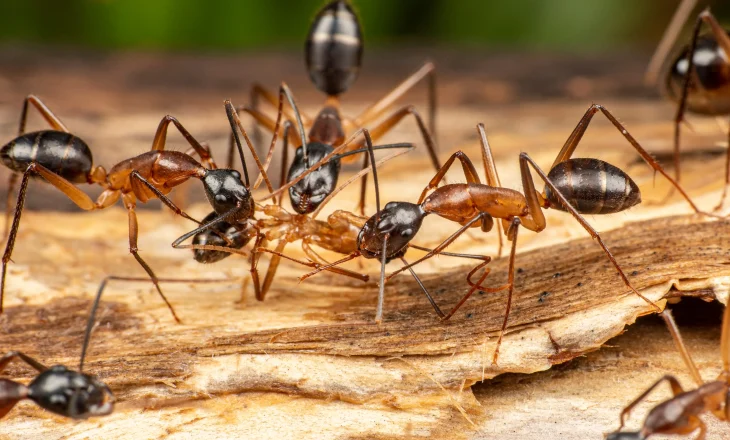
Welcome to Fox Pest Control’s ultimate guide on Carpenter Ants! Whether you’re dealing with an infestation or just curious about these tiny creatures, we’ll break down everything you need to know. From how many carpenter ants there are in the world to how to spot an infestation in your home, let’s dive in!
What Do Carpenter Ants Look Like?
There are over 15,000 species of ants! While we don’t treat all of them, we can help you identify what’s bugging you and take care of them.
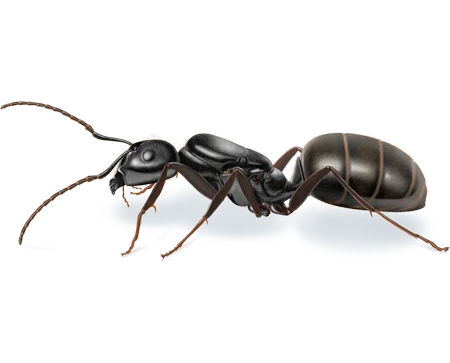
Queen
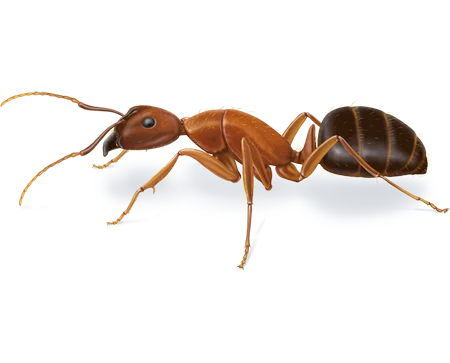
Red Carpenter Ant
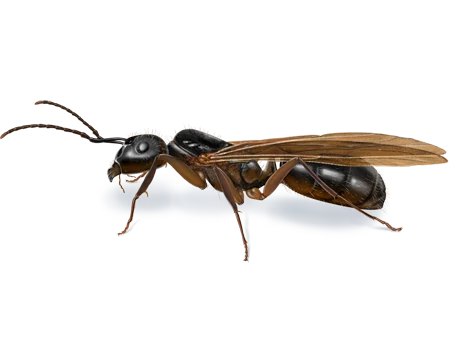
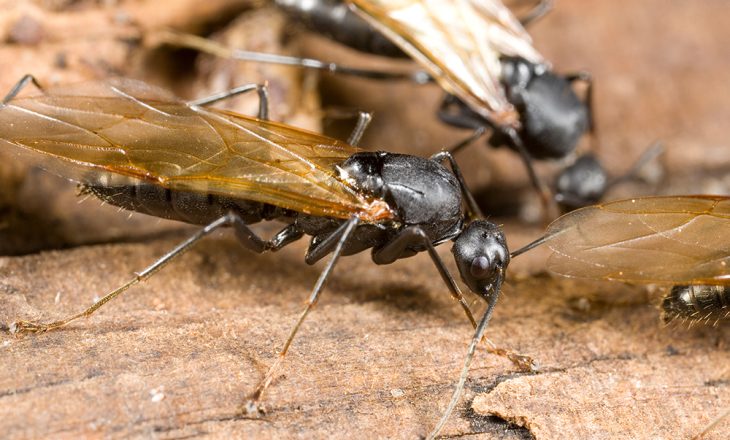
Swarmer
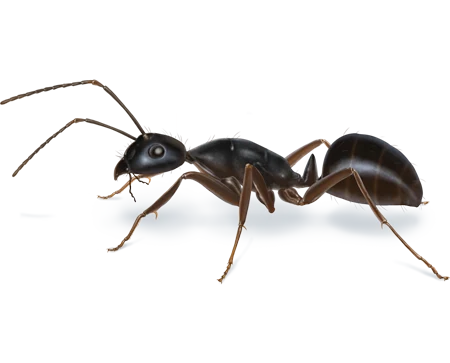
Worker
What in the World are Carpenter Ants?!
Carpenter ants might sound like they’d help you build a house, but they’re more likely to tear it down! These fascinating insects are found all over the world and can cause serious damage if left unchecked. Carpenter ants get their name from their ability to chew through wood, but here’s the twist: they don’t actually eat the wood like termites do. Instead, they tunnel through it to make elaborate galleries to create nesting sites.
There are over 1,000 species of carpenter ants around the world, and many of the most common live right here in North America. Camponotus pennsylvanicus, also known as the black carpenter ant, was first named in 1773, making it the first ant species in North America to be officially identified! This historical naming marks its place as an early subject of scientific discovery in the world of ants.
How Can You Tell It’s a Carpenter Ant?
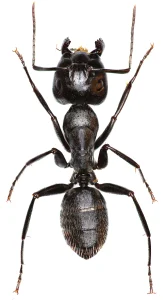
Carpenter ants are among the largest ants in North America, and because there are a lot of different species in the US, size and color can’t be the only determining factors. Carpenter ants come in a variety of colors—black, red, brown, tan, yellow, or a mix, depending on the species. Also, their size differs depending on their place in the colony. But we’ll get into that a bit later.
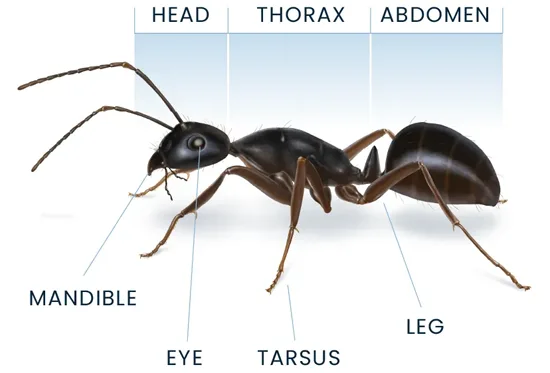
While carpenter ants share some common traits with other ant species—like a pinched waist and bent antennae—there are some key features that make them stand out. Just a note though – a lot of these characteristics aren’t visible unless under a microscope. So, for starters, their thorax is evenly rounded when viewed from the side, unlike the irregular shapes seen in other ants. They have just one node connecting their thorax to their abdomen and a unique fringe of hairs around the tip of the abdomen. Also, if you look closely, their head has a more heart-like shape compared to other ants.
If you’re seeing large black ants, there’s a good chance you have carpenter ants. But the easiest way to know if you’ve got a carpenter ant problem is if you see wood damage. We’ll get into the signs in a minute, but if you’re seeing sawdust-like debris and tunnels in wood, it’s a good idea to get an inspection from our specialists at Fox!
Do Carpenter Ants Bite, Sting, Damage Property, or Spread Disease?
Here’s what you really want to know—are carpenter ants a threat to you and your home? Let’s break it down:
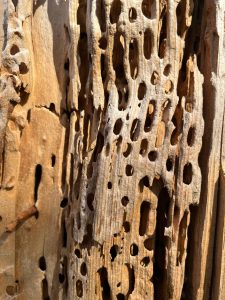
- Biting: So, yes, carpenter ants can bite, but don’t worry—they’re not aggressive biters. They usually bite only when they feel threatened, like if you disturb their nest or pick them up. Their bite isn’t just a pinch either; they can inject a small amount of formic acid into the wound, which can make it sting a bit more than a typical ant bite. While it might cause some discomfort, the good news is that carpenter ant bites aren’t dangerous to humans and typically heal quickly.
- Stinging: Unlike some other ants, like fire ants, carpenter ants don’t sting. This is a relief for anyone who’s dealt with stinging ants before! With carpenter ants, it’s all about the bite. So, while you may feel a sharp nip if you get too close, you won’t have to worry about any painful stings.
- Property Damage: This is where carpenter ants can become real troublemakers. Though they don’t eat wood like termites, carpenter ants chew through it to create tunnels for their nests, which is just as bad for your home. Over time, they can cause significant structural damage, especially if they’re left to their own devices for too long. They particularly love water-damaged or decayed wood, so if your home has moisture issues, it’s like rolling out the red carpet for them! The more they expand their colony, the more they weaken the wooden beams, joists, and furniture in your home, leading to expensive repairs down the road.
- Disease Transmission: Here’s some good news—carpenter ants aren’t known to spread diseases. They aren’t like roaches or rodents that can carry harmful pathogens. However, don’t let that fool you into thinking their presence is harmless. Carpenter ants often signal that there’s a moisture issue somewhere in your home, which could lead to mold growth or attract other pests, like termites or cockroaches, which are much worse when it comes to spreading germs. While the ants themselves aren’t directly dangerous to your health, the conditions they thrive in could be.
In short, while carpenter ants aren’t as overtly harmful as some pests, they can certainly become a threat to your home’s structure if not dealt with in time. Keep an eye out for the signs of infestation and take action early to avoid costly damage!
Life Cycle of Carpenter Ants
Let’s dive into the intriguing journey of a carpenter ant’s life, step by step! Carpenter ants undergo a complete metamorphosis, transitioning through four stages: egg, larva, pupa, and adult. This entire process, from egg to adult, can take anywhere from several weeks to a few months, depending on the specific species and environmental conditions. Each stage is crucial in shaping these fascinating insects into the hardworking colony members we often see in our homes!
- It All Starts with an Egg: Every carpenter ant begins its journey as a tiny, soft, oval egg—about the size of the period at the end of this sentence. Not every egg makes it to adulthood; some unfortunately become snacks for their nestmates.
- From Egg to Larva: When an egg hatches, out comes a worm-like larva that’s blind and legless. These little grubs are eating machines, relying completely on the adults to keep them fed. They grow quickly and shed their skin several times as they bulk up.
- Metamorphosis to Pupa: Once the larva has reached a good size, it undergoes an amazing transformation into a pupa. This resting stage is where the real magic happens. Pupae resemble adult ants more and more, with their legs and antennae tucked against their bodies. They start out a pale color and gradually darken. Some pupae spin cocoons for extra protection, while others stay exposed.
- Emerging as an Adult: Finally, the pupa breaks free as an adult ant! Freshly emerged adults tend to be lighter in color but will darken as they mature. Their exoskeletons harden, signaling that they won’t grow any larger from here on out.
Have a carpenter ant problem that needs fixing?
The Roles of Adult Carpenter Ants
Carpenter ants are social insects, living in colonies with a strict hierarchy. Remember how we said earlier that carpenter ants can be different sizes based on their role in the colony? We’re going to talk a little about each role and how they differ. Each colony has a queen, male drones, and worker ants, all with specific jobs and together they keep everything running smoothly. Let’s look at what each ant’s job is in a carpenter ant colony:
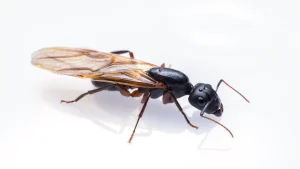
- Queens: The queens are the egg-laying powerhouses of the colony. A single queen can live for a very long time – up to 25 years if the conditions are right. A queen can lay thousands of eggs during her lifetime and that is her only job. Once the nest is established, she rarely ventures out.
- Workers: The workers are the backbone of the colony, taking on multiple responsibilities. They care for the queen and her young, forage for food, and expand the nest by chewing through wood. Some workers are larger and act as soldiers, bravely defending the colony from any threats. All carpenter ant workers are female.
- Males: Male carpenter ants have a single purpose—mating with the queen. Once they’ve completed this role, they typically die shortly afterward. These males often have wings and are easiest to spot during the swarming season, when carpenter ants take to the air to find mates.
Several times a year, you may notice swarms of winged carpenter ants emerging from the colony. These are future queens and their potential mates. Interestingly, colonies of the same species swarm simultaneously, often on the same night, creating a synchronized display. While these winged ants resemble workers, they’re larger and have two pairs of wings—the front pair noticeably larger than the back.
When the timing is right, these winged ants take flight to mate. After mating, queens shed their wings and find a suitable place to establish a new colony. They’ll dig into wood or soil to start building their new home, continuing the carpenter ant lifecycle.
Mistaken Identities: Carpenter Ant Copycats
Remember when we talked about reproductive carpenter ants growing wings to search for mates and new colony locations? Well, reproductive termites do the same thing, which makes it easy to confuse the two. Both winged carpenter ants and swarming termites, also known as alates, are on a mission to find the perfect spot to start a new colony.
If you see winged insects buzzing around, it’s smart to call Fox Pest Control to protect your home. While termites can be more destructive, having carpenter ants around isn’t great either. Knowing the differences between these winged insects can help you act quickly to safeguard your home. Check out the image below to see a few ways to tell them apart:
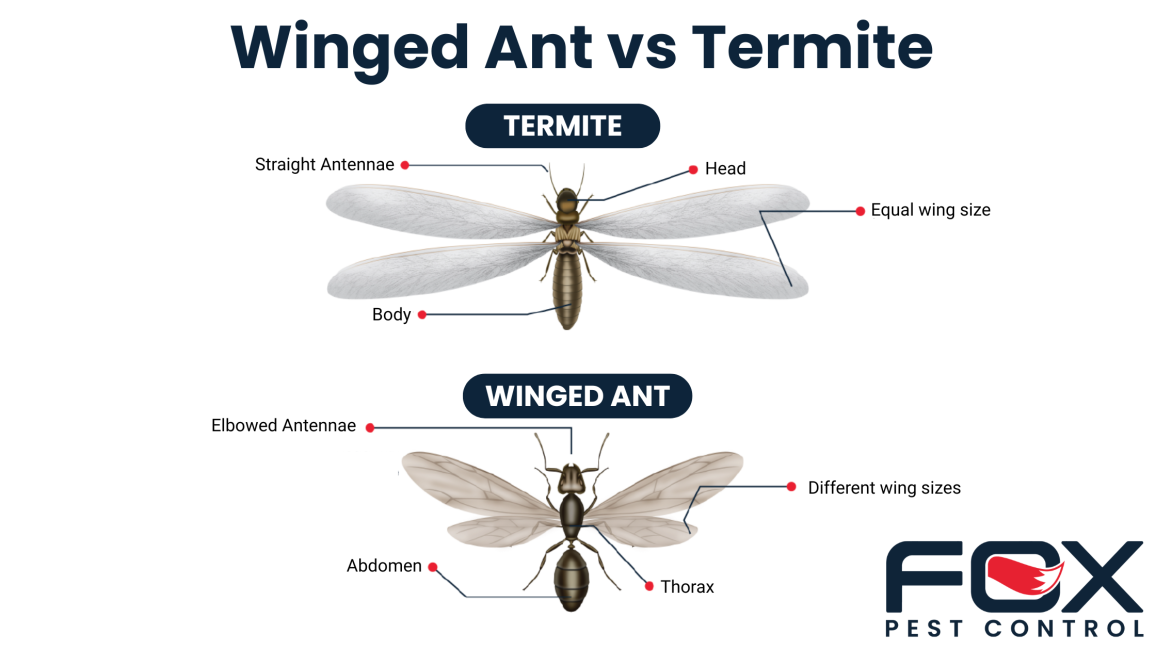
Body Shape
- Winged Termites: They have a uniform, straight, and broad body without a noticeable waist. Their abdomen appears almost as one solid line.
- Winged Ants: Carpenter ants have a distinct narrow waist between their thorax and abdomen, giving them a “pinched” or segmented look.
Antennae
- Winged Termites: Their antennae are straight and resemble tiny beads.
- Winged Ants: Carpenter ants have elbowed or bent antennae that curve, resembling a boomerang.
Wings
- Winged Termites: Both pairs of wings are equal in size and longer than their bodies, resulting in a rectangular, boat-like appearance.
- Winged Ants: The front wings of carpenter ants are noticeably longer than their hind wings, creating a more triangular, asymmetrical shape when folded.
Color
- Winged Termites: These insects are generally light or dark brown.
- Winged Ants: Carpenter ants typically range from dark brown to black, although some species can vary in color.
Swarming Differences Between Termites and Ants
- Winged Termites: Most species, like subterranean termites, tend to swarm in the spring, particularly after rainfall. However, drywood termites often swarm in late summer or early fall.
- Winged Ants: Carpenter ants typically swarm in late spring and early summer. Their swarming patterns can be influenced by environmental factors like temperature and rainfall, meaning they might emerge during warmer months in milder climates.
Behavior, Diet, and Living Conditions of Carpenter Ants
Carpenter ants are fascinating little critters with some unique behaviors that set them apart from other ants. Let’s take a closer look at what makes them tick.

First, carpenter ants got their name for a reason. They are really wood carvers, rather than consumers. Unlike termites, who eat wood, carpenter ants chew through wood to create galleries and tunnels for their nests. These tunnels are smooth and look almost sanded down. They prefer moist, decayed wood in nature, but when they move indoors, they gravitate toward water-damaged wood.
Because carpenter ants are surprisingly tidy for little pests, they push out the frass to keep their tunnels clean. This frass looks like little piles of sawdust-like shavings and are telltale signs that carpenter ants have been busy at work.
Carpenter ants are mostly active at night, and they leave trails between their nests and food sources so other carpenter ants can find their way. They are typically inactive during the winter, hibernating in their nests throughout the cold months. An exception to that is if their nest is in a heated area of a building – as long as they have a food source, they will continue to be active all year. In the Northeast, carpenter ants start to wake up around May, hit their peak activity in July, and slow down by October.
Let’s look at their nesting and foraging habits a bit more.
Carpenter Ant Nesting Habits
Carpenter ants live in massive colonies, often numbering in the tens of thousands! While an exact count of all carpenter ants globally would be impossible, we know they thrive wherever there’s wood and moisture. Their role in nature is important because they help break down decaying wood in forests, but when they invade homes, it’s a different story.
Carpenter ants make two kinds of nests: parent nests and satellite nests.
Parent Nests
Parent nests are usually found outside, hidden away in damp or rotting wood—think tree roots, stumps, fallen logs, or even wood buried underground. Around the house, they might show up in moist areas where wood touches the foundation or around windows. Indoors, parent nests are found in damp or decaying wood, which is often caused by leaks, condensation, or poor airflow. Common hiding spots include:
- Behind bathroom tiles
- Around tubs, sinks, showers, and dishwashers
- Under roofing, attic beams, or underfloor insulation
- In hollow areas like doors, curtain rods, wall spaces, and even foam insulation
Satellite Nests

Once the main colony is settled, carpenter ants often build “satellite nests” nearby. Workers from these satellite nests will travel back and forth to the parent nest. These satellite nests are usually in drier spots like insulation, solid wood, hollow doors, or wall spaces since they only house worker ants, pupae, and larvae that don’t need a lot of moisture.
As the colony grows, carpenter ants set up satellite nests in nearby trees or structures. Homes surrounded by big trees are often prime targets for these ants. Carpenter ants are also strong travelers—they can go more than 100 yards to find food or set up new nests!
Have a carpenter ant problem that needs fixing?
What Do Carpenter Ants Eat?
Carpenter ants have a mixed diet, making them pretty adaptable when it comes to food! They’re omnivores, which means they eat both plant and animal-based foods. Here’s a breakdown of their favorite meals:
- Sweet Tooth for Honeydew
- Carpenter ants love sweets, especially honeydew—a sticky, sugary substance produced by aphids and other small insects. Carpenter ants will actually “farm” aphids by protecting them from predators to keep their honeydew supply flowing. They’ll also go after other sugary foods, like fruits or syrups, if they’re indoors.
- Protein from Other Insects
- Carpenter ants are also hunters and scavengers, so they’ll eat dead insects, small invertebrates, or anything they can find that provides a good protein source. Protein is essential for growing larvae, so worker ants are on the lookout for it.
- Human Food
- When carpenter ants make their way into homes, they’re not too picky. They’ll go for whatever human food is available, especially sugary or protein-rich items. Sweets, meats, pet food, and crumbs are fair game.
- Moisture Matters
- While they don’t eat wood like termites, carpenter ants do need moisture to survive. That’s why you’ll often find them near water sources or damp areas like bathrooms, kitchens, or basements. These spots provide both shelter and easy access to their preferred foods.
Because carpenter ants are nocturnal, they’re usually out in search of food between sunset and midnight, often traveling long distances from their nests. But how do they know where to go to find food? They follow “ant trails” — clear paths that take them back and forth between their main nest and satellite nests. These are commonly found along tree branches, electrical wires, or even pipes and baseboards in homes.
These clear trails are actually marked by pheromones, which is one way that carpenter ants communicate. Let’s learn a bit more about how that works.
How Do Carpenter Ants Communicate?
Carpenter ants are fascinating little creatures, especially when it comes to how they communicate! Here’s a friendly look at their communication methods:
- Pheromone Trails: Carpenter ants use chemical signals called pheromones to mark their paths. When one ant finds food, it leaves a pheromone trail for others to follow. This helps create “ant highways” that connect their nests to food sources, making it easier for the whole colony to snack together!
- Tactile Communication: When ants meet, they often touch each other’s antennae. This friendly greeting helps them share information about food and check in with one another.
- Stridulation (Making Sounds): Carpenter ants can also make soft sounds called stridulation by rubbing their body parts together. They use these sounds, especially when they’re alarmed, to alert their fellow ants. It’s like sending out a little warning call!
- Scent Marking: These ants leave behind special scents from their glands to mark their territory and reinforce their trails. This helps keep the colony organized and ensures everyone knows where to go.
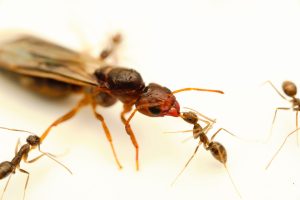
Here’s another fun fact about ants. When you see ants “kissing” by touching their mouths, they’re actually doing more than just feeding each other—they’re sharing important information, too! Scientists have discovered that along with food, ants pass along a mix of chemicals that help shape the whole colony.
Ants, bees, and other social insects have what’s called a “social stomach,” where they store liquid food to share later with other insects or their larvae. This mouth-to-mouth food sharing, or trophallaxis, doesn’t just pass on nutrients. It also shares the colony’s scent, which helps ants recognize each other. Scientists recently found that this shared fluid contains special proteins, hormones, and chemicals related to growth, digestion, and even the ants’ immune system.
One surprise was finding a juvenile hormone, which was thought to be only in the ants’ bloodstream. Passing this hormone to larvae is how adult ants seem to “decide” which larvae will grow into workers or soldiers, helping the colony adapt as needed. In experiments, larvae given hormone-laced food were more likely to mature and grow larger than usual, showing that the ants control their colony’s development based on its needs.
This discovery suggests that ants aren’t just feeding—they’re shaping the future of the colony, making sure every ant plays a role that benefits the group. Scientists think this might happen in other animals too, hinting that the power of saliva and shared food could be key in social behaviors across many species!
Signs of a Carpenter Ant Infestation
Okay, so we get it. Carpenter ants can be fascinating to learn about, but they’re not so much fun when they’re invading your space and damaging your property. It’s important to learn the signs of a carpenter ant invasion so you can know when you need to call in the experts. It can be tricky to spot the signs, but here are a few clear indications that you have a problem:
- Sawdust Piles (Frass): Remember, carpenter ants don’t eat wood like termites—they chew it up to make tunnels. As they dig through wood, they kick out little piles of sawdust (called “frass”), which you might find near their nest openings or along walls and floors.
- Rustling Sounds: If you’re hearing faint rustling or crunching sounds inside your walls, it could be carpenter ants at work. They’re usually more active at night, so listen carefully if things go quiet around the house!
- Ant Trails: Carpenter ant trails follow along tree branches, pipes, or even baseboards as they move between their main nest and satellite nests. Look for a line of big black ants moving around your yard or near your home.
- Winged Ants (Swarmers): In spring or early summer, you might see winged carpenter ants swarming. These are reproductive ants looking to start new colonies, and if they’re inside your house, it’s a good sign there’s a nest nearby.
- Wood Damage: If you notice wood that sounds hollow or seems damaged, especially around windows, door frames, or wooden structures, it could mean ants are nesting inside.
If you spot any of these signs, it’s time to take action to keep these big ants from doing any more damage to your home!
Have a carpenter ant problem that needs fixing?
What You Can Do About Carpenter Ants
So, you saw the signs, and you know you’ve got Carpenter Ants. Or, you don’t see any signs but want to make sure you don’t have a neon sign advertising a vacancy for them to move in. We have some great tips to help make your home less inviting to these pesky insects.
Here’s a quick list to help keep carpenter ants away from your home:
- Clear out stumps, logs, and old wood within 100 yards of the house. Carpenter ants love damp, decaying wood, so keeping these far from your home is key.
- Keep plants and trees, especially evergreens, from touching your house. Ants use these as highways to get inside!
- Store firewood off the ground and away from the house. Bring it inside only when you need it to avoid attracting ants.
- Repair any leaks or damaged wood around the roof, gutters, and foundation to keep wooden areas dry.
- Replace any water-damaged or rotting wood—carpenter ants aren’t as interested in dry wood.
- Paint and seal exterior wood to keep it protected and less appealing to pests.
- Seal gaps around pipes and wires where ants might sneak in.
- Use pressure-treated wood for parts of the house that contact soil, as this deters ants and other pests.
- Lay down a moisture barrier (like a plastic sheet) over soil in crawl spaces and make sure these spaces have good ventilation.
How Do I Get Rid of Carpenter Ants?
To eliminate carpenter ants, the parent and the satellite nests must be found and eliminated. This is why you need the help of the professionals at Fox Pest Control to really protect your home against carpenter ants. We know all about carpenter ants and what to do to get rid of them. When you combine the tips above with our Home Protection Plan, you get year-round protection from carpenter ants and many other common household pests. We’ll help you spot entrance points, unsealed areas, and potential issues that are causing the infestation. Our technicians get regular, on-the-ground training and know how to provide the best carpenter ant pest control. You can count on Fox to give you peace of mind and help you feel comfortable and safe in your home. Give us a call today!